Editorial update · 29 September 2026
I wrote this article before meeting Joni and Tania, the founders of Sanka + Bira, at Jakarta Tea Passport last weekend.
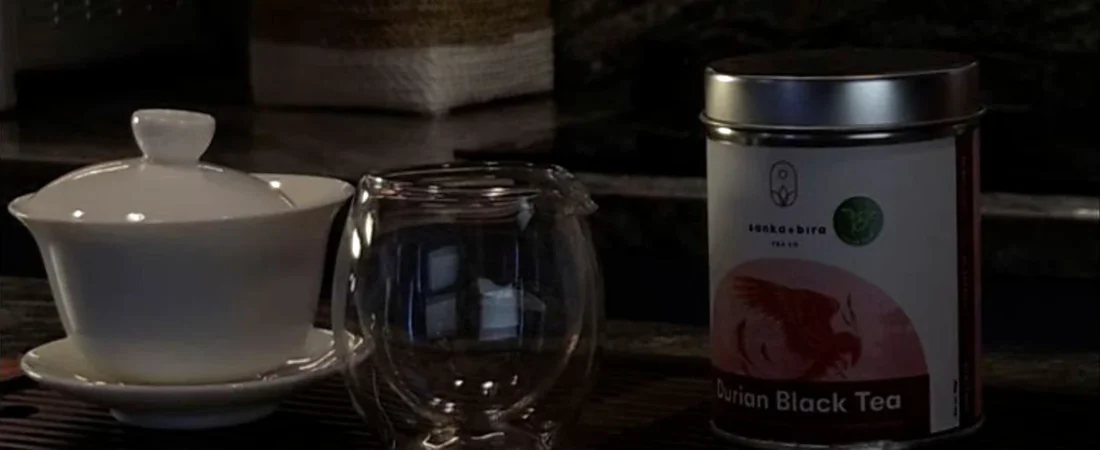
I told them how much I enjoyed their Durian Black Tea: it was unusual without feeling like a novelty, and the durian remained recognisable without completely swallowing the tea. They then gave me the sad news that the product has been discontinued. Some stock is still available, so I will probably be putting a few bags aside while I can.
They also clarified an important detail about how the tea was made. It was not dosed with durian essence or flavouring, and there are no pieces of dried durian mixed into the finished tea. It was scented: the tea was kept close to durian fruit so that the leaves could take on its aroma.
That distinction makes the process—and what I tasted—more interesting. I would now describe it more precisely as a naturally scented black tea rather than simply a flavoured tea.
I did not ask why the product was discontinued. Durian’s polarising appeal and the additional variables involved in natural scenting may have contributed, but that is only my interpretation, not an explanation given by Sanka + Bira.
The change in availability does not undo the tasting recorded below. The tea still made a convincing case for an Indonesian flavour being expressed through tea with restraint and a clear sense of place. You can read the original article below as a record of a tea approaching the end of its run.
Can durian black tea be more than a memorable gimmick?
Durian and black tea sounds like it could easily become a gimmick. Two strong identities placed together because the combination is easy to remember.
But this one worked.
I brewed the Durian Black Tea from Sanka + Bira in a gaiwan and pushed it with longer steeps at 100°C. It stayed smooth and composed, with barely any noticeable astringency. Unusual, tropical, and distinctly Indonesian.
Sometimes tea does not have to taste like somewhere else.
Sometimes it can taste like home.
What makes durian black tea work?
Durian is difficult to make neutral. For people who know it, the fruit carries place, season, texture, memory, and a smell that refuses to remain politely in the background.
Putting that character into tea creates an immediate risk: the flavour can become the entire story. The leaf disappears and novelty takes over.
What surprised me in this cup was its restraint. The durian character was recognisable, but the drink still behaved like tea. There was structure beneath the aroma. Heat and longer contact did not turn it into a rough extraction. The combination felt considered rather than loud for its own sake.
That distinction matters.
Scented tea deserves the same attention
It is easy to treat scented tea as a separate, less serious category—or to excuse a weak base because the additional aroma is attractive. Neither response is useful.
The same questions still apply.
What is the tea material? How is the additional character created? Does the aroma feel integrated? Is the body convincing? Does the finish stay clean? Can the tea handle repeated infusions, and does it remain interesting once the first aromatic impact settles?
A memorable flavour is not a substitute for the rest of the cup.
In this session, the smoothness mattered as much as the durian. So did the lack of aggressive astringency when the tea was pushed. Those qualities kept the experience from collapsing into a single novelty note.
Indonesian tea in its own voice
Tea culture often teaches us to look elsewhere for legitimacy. Names, regions, vessels, and reference flavours arrive with established histories, and those histories deserve respect.
Respect does not require Indonesia to disappear from the table.
A contemporary tea culture here can remain connected to wider traditions while responding to local agriculture, flavour, music, design, and daily life. It can be precise without becoming imitative. It can recognise a durian note as more than exotic decoration for somebody else’s audience.
The interesting question is not whether an Indonesian tea can resemble a famous tea from somewhere else.
It is whether the material, process, and idea come together clearly enough to be worth another cup.
Curiosity before category
I did not expect this combination to feel composed. That was exactly why it was useful to taste.
Curiosity does not mean lowering the standard. It means giving the cup enough room to answer before the category answers for it.
This one answered with warmth, funk, and a sense of place.
Home can be a tasting note too.